Cover image courtesy of phototrend.fr
This Feedback Comes From a Place of Love
I want to start this article by making something abundantly clear: I like Samyang lenses. Actually, I really like Samyang lenses.
I've owned a frankly unreasonable number of them over the years, and there are currently seven of them sitting in my lens cabinet. I recently rebought the Samyang 135mm f/1.8 after selling mine because I missed it. The tiny 100mm f/2.2 has become one of my favorite lenses to bring to micro weddings as a companion to the Sony 28-70 f/2 GM. I use the 18mm f/2.8 when I need something wider without adding any meaningful size or weight to my bag. I've owned multiple copies of the 85mm f/1.4 over the years. And I've tried pretty much every lens in their compact prime series, especially during cocktail hour as a way to take some weight off my back after an hour-long wedding ceremony that I shot with the 50-150mm f/2 GM on one camera and the 28-70 f/2 GM on the other.
So this isn't going to be one of those articles where someone complains about a camera company whose products they don't actually use. Quite the opposite. I think Samyang is currently one of the most interesting lens manufacturers making lenses for Sony E-mount cameras. They're willing to make weird things, experiment with focal ranges, and sell lenses at prices that don't require me to contemplate selling an organ. Their compact sizes and lightweight designs, paired with sharp optics that have just enough character to their rendering, are reasons they're mainstays in my bag.
Some of the prototypes they've recently shown make me really excited about where they're going, but one of them leaves me scratching my head.
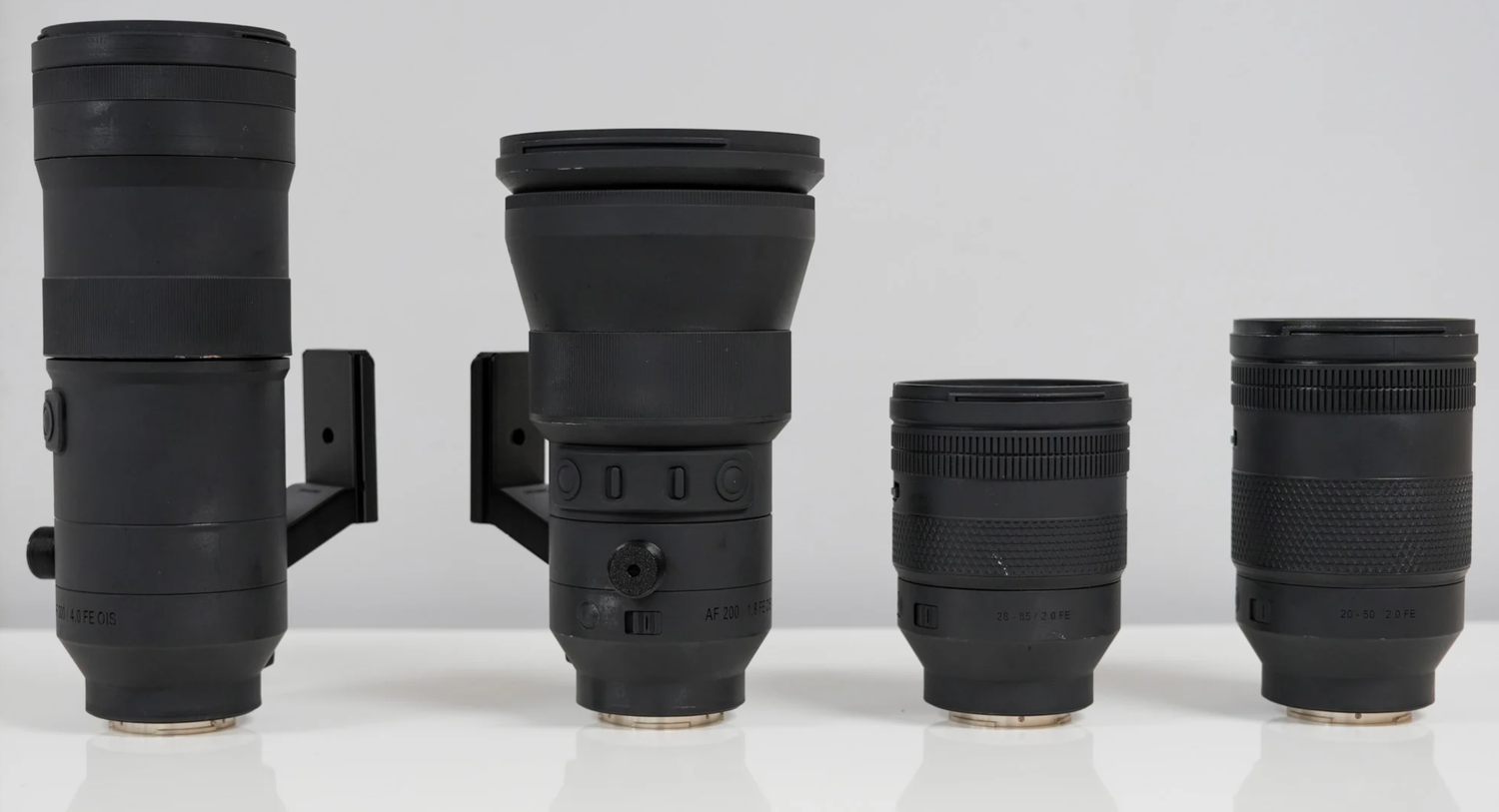
Samyang has shown prototypes of both a 28-135mm f/2.8 and a 28-85mm f/2-2.8, among others. The first one sounds like exactly the kind of lens I want to see manufacturers making right now. The second? I'm not entirely sure of its value.
The 28-135mm f/2.8 Is Exactly What I Want From Samyang
Let's start with the one I like.
A 28-135mm f/2.8 is weird, and that's a good thing. Sigma has already pushed the conventional standard zoom farther with its 28-105mm f/2.8 DG DN Art. Samyang apparently looked at that and decided 105mm wasn't enough.
Going all the way to 135mm fundamentally changes what the lens can do for event photography. At 28mm, I can photograph most environmental and documentary moments during a wedding day. At 50mm, I have something normal. At 85mm, I'm comfortably into portrait territory. At 135mm, I can reach across a ceremony or reception for a tight candid without immediately switching to a dedicated telephoto lens. All at f/2.8.
It's not necessarily a lens I'd personally use for every wedding, especially because size, weight, and prime-speed apertures matter enormously to me, but I immediately understand who it's for and why they would buy it.
More importantly, it fills a legitimate gap in the current market. Sigma's 28-105mm f/2.8 is an interesting lens, but 105mm still stops short of what I'd consider genuine telephoto event coverage. Samyang pushing the concept all the way to 135mm makes it something different.
Samyang also already has the 35-150mm f/2-2.8 for photographers willing to give up the wide end in exchange for another 15mm of reach and a brighter aperture through part of the range. Those two lenses make sense sitting next to each other. The 28-135 prioritizes the wide end and a constant aperture, while the 35-150 prioritizes telephoto reach and a brighter wide end.
Now explain the 28-85mm to me.
What's the Appeal of the 28-85mm f/2-2.8?
On its face, a 28-85mm f/2-2.8 sounds intriguing. Twenty-eight to 85 millimeters covers a useful range, starting at f/2 sounds exciting, and 85mm is meaningfully longer than a traditional 24-70mm. It competes with Tamron's 28-75mm f/2.8 and Sigma's 28-70 f/2.8 rather well. If Samyang can keep it similarly compact, lightweight, and affordable while adding another 10-15mm of reach and a brighter aperture at the wide end, that's a genuinely compelling proposition. But when it comes to finding a place in a working wedding photographer's kit in the era of f/2 zoom lenses, I'm a little underwhelmed.
If Samyang releases the products it has shown, its lineup would include a 28-85mm f/2-2.8, 28-135mm f/2.8, and 35-150mm f/2-2.8. At that point, what exactly is the 28-85 giving a professional in exchange for losing 50mm from the long end of the 28-135?
Presumably some amount of size and weight, and yes, it starts brighter than f/2.8. But if it works its way toward f/2.8 relatively quickly as you zoom, that distinction becomes considerably less exciting. If I'm willing to carry a larger standard zoom lens than their recently released 24-60mm f/2.8 anyway, and the 28-135mm f/2.8 isn't the best option, the 35-150 gives me the f/2-2.8 headline aperture while reaching significantly further. That's a huge difference.
The 28-85 therefore needs to do something really well to justify the sacrificed range, and looking at the prototypes Samyang has displayed so far, it doesn't appear to be an exceptionally tiny lens. Maybe the production version will surprise me, but based on what we've seen so far, I'm struggling to find its killer feature.
The Problem Isn't 28-85mm. It's f/2-2.8.
This is the frustrating part because I think Samyang is really close to making something I (and many others) would immediately buy. Keep the focal range. Change the aperture.
Give us a 28-85mm f/2.2. It'd be larger, sure. But it'd be worth it.
My current primary wedding lens is the Sony 28-70mm f/2 GM, and it has fundamentally changed the way I photograph weddings. I used to rely much more heavily on primes, and I still prefer them during dedicated portrait time or low light and no-flash receptions, but the 28-70 gives me something more valuable during the documentary portions of a wedding day: I don't have to think very much about my lens.
That sounds boring, but it's kind of the highest compliment I can give a piece of professional equipment. When I'm photographing someone getting ready and suddenly their mom starts crying in the corner of the room, I don't particularly care about an MTF chart. I care that I can go from photographing the room to photographing her expression immediately.
The Sony gives me that flexibility while retaining prime-adjacent light gathering and depth of field. The problem is that it stops at 70mm. If Samyang gave me a 28-85mm f/2.2 that wasn't substantially larger than the Sony, I'd buy it. I might sell the Sony.
Losing a third of a stop while gaining significant range is exactly the kind of compromise I want manufacturers experimenting with. Eighty-five is long enough to reach across a small room for a candid or make a legitimately tight portrait, while f/2.2 still offers a shallow enough depth of field that I'd happily photograph an entire day with it if I could. Hell, I already use the 28-70 f/2 in combination with Samyang's 100mm f/2.2 for exactly that reason; I know how effective it can be on a wedding day.
More importantly, an f/2.2 version of the lens suddenly has an obvious position in Samyang's lineup. The 28-85 prioritizes aperture, the 28-135 prioritizes overall range, and the 35-150 prioritizes the telephoto end. Then, I'd understand why all three exist.
Or Forget 28mm and Give Me 24mm
There's another version of this lens that might interest me even more: a 24-85mm f/2.5.
If I could magically alter one thing about my Sony 28-70mm f/2 GM, I wouldn't make it sharper. I wouldn't make it f/1.8. I'd make it start at 24mm.
Twenty-eight millimeters is wide enough until it isn't. I've photographed plenty of getting-ready spaces, restaurants, courthouse weddings, and small receptions where I physically cannot back up any farther. That's why I still carry something wider alongside the Sony (usually a Samyang 18mm f/2.8), even though I might only use it for a handful of images.
Going from 28mm to 24mm changes that substantially.
A 24-85mm f/2.5 would give me a lens I could put on my camera at the beginning of a well-lit wedding day and potentially leave there until dedicated portraits or the reception gets extremely dark. Or, paired with a flash, it would literally be the perfect dance floor lens. Twenty-four for the room and/or dancing, 35 for documentary work as I navigate getting ready and/or cocktail hour, 50 for the in-between moments where flexibility is vital, and 85 for tighter candids, details, ceremony shots, and portraits. The way I see it, it's the ideal micro-wedding lens, while the 28-135 f/2.8 is the ideal "all-in-one" full-wedding lens. And each major focal length has its place for either lens contextually.
I'm under no illusion that I could simply ask for a 24-85 f/2 or even f/2.2 either. Compromises have to happen. The fabled 12-600 f/0.95 will never happen, and for good reason. That's where f/2.5 comes in; to (hopefully) make the lens have a more tenable design. I'd happily give up two-thirds of a stop from my Sony to gain 24mm on one end and 85mm on the other. That's a compromise that actually changes how many times I need to open my camera bag during a wedding.
And if optical or manufacturing realities mean Samyang absolutely needs to stick with f/2-2.8, I'd still find a 24-85mm f/2-2.8 substantially more interesting than 28-85. At least then it's accomplishing something neither of the other two lenses does. You'd have a 24-85mm f/2-2.8 for photographers prioritizing width and presumably size/weight, a 28-135mm f/2.8 for overall versatility, and a 35-150mm f/2-2.8 for photographers prioritizing reach, with the concession that a 24mm prime might need to hang from your second body. Those are three different lenses for three different photographers.
How Have We Not Made a Modern 35-85mm?
Here's where things get nerdier. I recently bought an old Vivitar 35-85mm f/2.8. This thing is old. It's manual focus, heavy, and built like something I could use to defend myself in a parking garage. And although its bokeh and flare character is unique, I'm definitely not suggesting that every modern wedding photographer rush to eBay and buy one.
What fascinates me is that somebody figured out decades ago that 35-85mm makes an incredibly useful zoom range, and then the camera industry apparently collectively forgot about it. It's especially strange because 35mm and 85mm might be the most classic two-prime combination in modern wedding photography.
Wedding photographers have been putting a 35mm prime on one camera and an 85mm prime on another for years. It makes perfect sense. Thirty-five is wide enough to tell a story without looking aggressively wide, while 85 gives you the tighter portraits, candids, and compression that 35 can't. You can cover an enormous amount of a wedding day by bouncing between those two camera/lens setups.
So why has basically nobody looked at that extremely popular two-prime setup and thought: what if the entire space between those lenses was one zoom?
Here's my radical suggestion: design a modern, autofocus 35-85mm f/2.
Yes, 35mm isn't particularly wide. That's the compromise, and I think that's okay. Not every lens needs to do everything. We've gotten so accustomed to standard zooms beginning at 24 or 28mm that anything narrower immediately sounds limiting, but wedding photographers have already demonstrated for years that they're perfectly capable of using 35mm as their wider focal length.
The tighter wide end and reduced ratio should buy us something in return. Make it f/2. Make it relatively compact. Make it lighter than the Sony 28-70mm f/2. Make it cheaper. Ideally (but unrealistically), do several of those things. Pair it with a 20mm or 24mm prime on my second body for the handful of times I genuinely need to go wide, and I could photograph pretty much the entire wedding with it.
There's also something funny about a hypothetical 35-85mm f/2 competing against the Sony 28-70mm f/2. On paper, the Sony looks more versatile because 28mm is obviously wider than 35mm. In practice, I'm not convinced every wedding photographer would choose those seven millimeters over the extra 15mm at the long end. Especially when 35 and 85 are already focal lengths we know work beautifully together.
Vivitar was playing with this idea decades ago. I think it's time somebody tried it again with autofocus. And who better than a lens manufacturer who has been trying to establish themselves alongside Sigma and Tamron as a top-tier third-party lens manufacturer, especially after finally officially becoming an E-mount partner.
Samyang Is Getting the Bigger Idea Right
I don't want the title of this article to make it sound like I think Samyang has a bad lens roadmap. I actually think the opposite is true, which is why the 28-85 stands out to me so much.
The 20-50mm f/2? Take my money. That would put all other cocktail hour lenses to shame. The 300mm f/4? Interesting, particularly because there are no 300mm primes competing with Sony's GM. The 200mm f/1.8? If the price is right, that's the kind of thing I'd preorder first, think about second.
And the 28-135mm f/2.8? That is exactly the sort of lens I want them making. Don't give me Samyang's version of the same 24-70mm f/2.8 that everyone else has already perfected. Give me something weird. Twenty-eight to 135 is weird. Thirty-five to 150 was weird when that concept first appeared. That's good! The industry needs more of that.
...which is precisely why the 28-85mm f/2-2.8 seems strange to me. It's sitting between two considerably more versatile lenses without, at least from what we've seen so far, offering an equally compelling reason to choose it.
If it's dramatically smaller and lighter than those lenses, I'd likely eat my words. And given what Samyang has said about positioning it against lenses like the Tamron 28-75mm and Sigma 28-70mm, there's a very real possibility that's exactly what they're planning. Or, if Samyang manages some magical aperture progression where it stays near f/2 through most of the range, that changes the conversation too, and the lens would remain competitive in the wedding and event photography landscape.
But if it's a relatively large 28-85 that reaches f/2.8 fairly early? I don't get it.
Samyang, Make the Compromise More Interesting
If the specifications aren't finalized yet, here's my completely unsolicited (and perhaps fanatical) request as someone who photographs weddings for a living:
Give me a 28-85mm f/2.2 and I'll almost certainly replace my Sony 28-70mm f/2 GM.
Give me a 24-85mm f/2.5 and I'll carry it all day whenever I have enough light.
If it absolutely needs to be variable aperture, give me a 24-85mm f/2-2.8 and make it the wider counterpart to the 35-150.
Or throw the rulebook out entirely and resurrect the 35-85mm, this time at f/2, as a competitive, high-tier option whose niche is untouched in the modern industry. Wedding photographers already love the two ends of that range. Put everything between them into one lens.
Meanwhile, please make the 28-135mm f/2.8. Please make the 20-50mm f/2, even if it weighs over two pounds. These ones I understand immediately. They push existing boundaries substantially into territory nobody else is really serving and give event photographers another genuinely different choice. Samyang has already done a great job at differentiating themselves in their offerings through size/weight/cost savings; now it's time to truly shake up the market and make something premium.
I realize lens engineering is slightly more complicated than me sitting behind my computer saying, "Just make it 24mm!" There are optical compromises, weight compromises, autofocus considerations, manufacturing costs, and presumably at some point an engineer would like to go home and see their family.
But that's exactly why this moment in lens design is so interesting. We've basically perfected the conventional 24-70mm f/2.8. I don't think we need ten more versions of it. I want manufacturers to make the compromises weird again. The 28-135mm suggests Samyang understands that. I just wish the 28-85mm did too.